







In This Article
- What challenges arise from increased screen time?
- What mechanisms can make screen time beneficial?
- How can parents effectively monitor screen use?
- What practical applications support healthy screen habits?
- What risks are associated with excessive screen exposure?
It’s understandable that children and adults may be using screens (television, devices, tablets and video games) more than they typically would, or exceeding the recommended limits of one hour per day for kids ages two to five, and no screen time for kids under 18 months of age (with the exception of video chatting).
As child psychologists and screen time researchers, we are receiving questions from parents about how to manage children’s screen time during these unprecedented times. Those questions include: “How much is too much screen time?” and “Can screen time be beneficial in some cases?”
1. Select high quality, educational programming
Screen time can benefit kids over the age of two, when it’s the right type of content. In our research, we find that programming developed with education in mind, such as Sesame Street, can have some small but beneficial effects on children’s language skills.
Higher quality programs are more likely to gear their content to the needs of young children by having a coherent story line and by pacing the program to the developmental level of children. Educational programs often label objects and speak directly to children, which can be helpful for learning new words and sounds.
In children under the age of two, research suggests very little learning occurs from screens, even if the content is educational. Thus, limiting screen use in very young children to video-chatting with family and friends or short bouts of screen viewing (10 to 15 minutes) may be the best approach.
2. Watch or engage in screens together
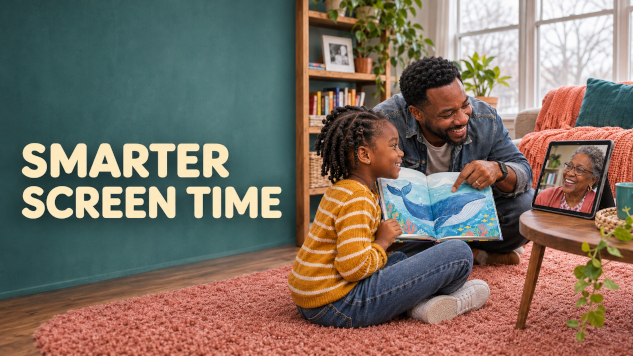
There is evidence to suggest that when children and caregivers watch screens together children are more likely to learn new words. Past research has shown that parents can help their children when using media together by directing their child’s attention to specific content, discussing what is being viewed and reinforcing what they have learned by making it relatable to the child’s day-to-day activities (e.g., “That’s a blue truck!”).
This means that when possible, sit down with your child and enjoy media together. Talk about what you are seeing on the screen and get children thinking about what they are watching by asking them engaging, open-ended questions (e.g., “What happened to character X today?”, “Character X is sad, why do you think that is?”), or by describing or labelling what’s on the screen (“Dora has a backpack on and Boots is purple!”).

3. Use screens for human connection
Pediatric guidelines encourage using video chats with family, friends and loved ones, even for young infants and children. Social connection is important for children and is seen as a healthy way to use devices.
Consider reaching out to family members, as well as neighbours in your community, school mates and friends to stay socially connected. Ask the individual on the video chat to interact with your child by singing, dancing and/or reading them a story.
You can also join the caremongering movement and engage your child in social activities that are safe at a distance within your neighbourhood (for example, a neighbourhood window scavenger hunt).
4. Balance screen time with other activities
We know that children learn best when they are engaging in interactions or conversations with their parents, siblings or grandparents. These “serve and return” or back-and-forth exchanges between parents and children, are the building blocks of children’s brain development. Try to offset screen-time activities with ample serve-and-return interactions that build children’s brain and bodies.
While parents may loosen up screen time limits, we don’t want them to throw out all the rules! That’s because there is evidence, especially early in child development, that too much screen use is associated with poor brain development, as well as delays in children meeting their developmental milestones (like walking, talking, writing). However, these results are based on children who have patterns of screen use that lasted longer than a few weeks of social distancing.
A good idea might be to create a schedule for online as well as offline activities, such as physical activity, sleep, healthy eating, reading, learning activities and device-free family time. Together, these activities can help children maintain mental and physical health. Also, screen use before bedtime can impact kids’ quality and duration of sleep, so when planning your schedule, try to reserve the last 60 minutes of the day for device-free time (a board game or reading time, for example).
5. Model healthy device habits
We have all been bombarded by the news and social media feeds, and it’s easy to get sucked into a digital vortex without noticing how much time we are spending on devices. Despite the desire to consume the most recent updates, it’s important to monitor our own media consumption because it can have an impact on levels of child use and interrupt those crucial serve-and-return interactions.
We can be media mentors to children by modelling healthy device habits. We can do this by taking media breaks and modelling device-free priorities (such as reading, cooking, eating, walking) ourselves.
Finally, although parents should talk to their kids, try to avoid exposing children to television and media reports regarding the pandemic since viewing disturbing news reports has been shown to elevate children’s stress levels.
It’s important that we help our children navigate screen use in the best possible way during this uncertain time.
About The Author
Brae Anne McArthur, Postdoctoral Research Fellow, Determinants of Child Development Lab, University of Calgary and Sheri Madigan, Associate Professor, Canada Research Chair in Determinants of Child Development, Owerko Centre at the Alberta Children’s Hospital Research Institute, University of Calgary
This article is republished from The Conversation under a Creative Commons license. Read the original article.
Further Reading
-
How to Talk so Little Kids Will Listen: A Survival Guide to Life with Children Ages 2-7 (The How To Talk Series)
Joanna Faber and Julie King offer practical ways to acknowledge young children’s feelings, invite cooperation, and ease everyday transitions. Their examples give caregivers language to try when a child wants one more episode and it’s time to move on.
Amazon: https://www.amazon.com/exec/obidos/ASIN/150113163X/innerselfcom
-
How to Break Up with Your Phone: The 30-Day Plan to Take Back Your Life
Catherine Price guides readers through noticing when they reach for their phones and changing the cues that make checking automatic. For caregivers, those changes can make it easier to give children their full attention during meals, play, and conversation.
Amazon: https://www.amazon.com/exec/obidos/ASIN/039958112X/innerselfcom
-
Good Inside: A Guide to Becoming the Parent You Want to Be
Becky Kennedy shows how parents can hold a boundary while staying connected to a child who is upset about it. Her examples help caregivers think through moments like ending a game or putting a tablet away at bedtime.
Amazon: https://www.amazon.com/exec/obidos/ASIN/0063159481/innerselfcom
Article Recap
Balancing screen time with interactive activities is essential for children's development. Parents should create structured schedules that prioritize both screen time and device-free interactions.
#InnerSelfcom #ChildDevelopment #ScreenTimeManagement #EducationalMedia #ParentingTips #MentalHealth #FamilyEngagement