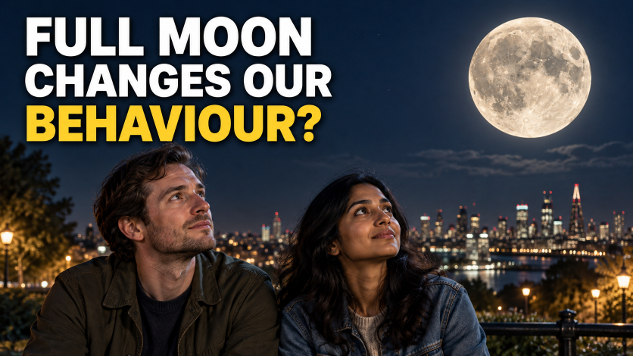
The belief that the Moon influences human behavior, particularly in terms of crime and social antics, has persisted for centuries. However, studies reveal little evidence supporting this notion, suggesting that any perceived effects may stem from cognitive biases rather than lunar phases. Understanding these misconceptions can help clarify the relationship between celestial events and human actions.
In This Article
- What tension exists around the Moon's influence on behavior?
- What mechanisms link the Moon to human actions?
- How do studies examine the Moon's effects on crime?
- What practical applications arise from understanding lunar impacts?
- What risks or limits are associated with believing in lunar effects?
If past months have been anything to go by, this will be accompanied by a round of public chat about how this affects human behaviour – claims of more hospital admissions and arrests, to crazy antics in children.
Beliefs in the Moon’s behavioural effects are not new and date back to ancient times. But what evidence is there that the Moon has an impact on behaviour?
As a criminologist, I look at evidence related to arrests and behaviour linked with criminal activity.
The only explanation I can see that links criminology with Moon phases is just about the practicalities of being a criminal: when it’s a full Moon, there’s more light.
While somewhat dated, one of the most significant studies looking at Moon phases and linking this with behaviour is a 1985 meta-analysis – a study of the findings of 37 published and unpublished studies. The paper concludes it is not sound to infer that people behave any more – or less – strangely between Moon phases. The authors write:
Alleged relations between phases of the moon and behavior can be traced to inappropriate analyses […] and a willingness to accept any departure from chance as evidence of a lunar effect.
Two more recent studies have looked at links between criminal activity and phases of the Moon.
A study published in 2009 looked at more than 23,000 cases of aggravated assaults that took place in Germany between 1999 and 2005. The authors found no correlation between battery and the various lunar phases.

A study reported in 2016 was careful to make a distinction between indoor and outdoor crime committed in 13 US states and the District of Columbia in 2014.
The authors found no link between lunar phases and total crime or indoor crime.
But they did find the intensity of moonlight to have a substantive positive effect on outdoor criminal activity. As moon illumination increased, they saw an escalation in criminal activity.
One explanation for this finding is what is referred to as the “illumination hypothesis” – suggesting that criminals like enough light to ply their trade, but not so much as to increase their chance of apprehension.
It may also be that there is greater movement of people during lighter nights, thus providing a bigger pool of victims.
Why do some people still cling to the belief that the Moon causes criminal or other antisocial behaviour? The answer most likely lies in human cognition and our tendency to focus on that which we expect or predict to be true.
During an expected lunar event – such as a full or super Moon – we expect that there will be a change in behaviour so we pay more attention when we see it. In the area of cognitive psychology this is known as confirmation bias.
But other questions remain, including why any behavioural effects must be inherently negative? Even if there was a direct effect, explanations as to why acts of kindness and altruism do not increase or decrease during Moon phases are conspicuously absent.
It is likely that we just assume the folklore is true, and believe that we become the werewolf and not the sheep.
About The Author
Wayne Petherick, Associate professor of criminology, Bond University
This article is republished from The Conversation under a Creative Commons license. Read the original article.
Further Reading
-
The Demon-Haunted World: Science as a Candle in the Dark
Carl Sagan explores how scientific thinking helps us evaluate extraordinary claims and distinguish evidence from compelling stories. His tools for questioning assumptions offer a useful starting point for examining longstanding beliefs about the Moon and human behaviour.
Amazon: https://www.amazon.com/exec/obidos/ASIN/0345409469/innerselfcom
-
Why People Believe Weird Things: Pseudoscience, Superstition, and Other Confusions of Our Time
Michael Shermer examines why people embrace unusual claims and why those beliefs can survive contradictory evidence. He explores the habits of reasoning that allow coincidences and selective observations to become convincing explanations.
Amazon: https://www.amazon.com/exec/obidos/ASIN/0805070893/innerselfcom
-
Thinking, Fast and Slow
Daniel Kahneman explains how intuitive judgments and mental shortcuts shape our understanding of events. His examination of cognitive biases helps readers recognize why memorable incidents can seem to establish a pattern, even when broader evidence fails to support it.
Amazon: https://www.amazon.com/exec/obidos/ASIN/0374533555/innerselfcom
Article Recap
The Moon has little proven impact on human behavior, particularly regarding crime, with studies indicating that increased moonlight may actually correlate with higher criminal activity. To avoid misconceptions, it's essential to critically evaluate claims about lunar influences.
#InnerSelfcom #LunarInfluence #CriminalBehavior #ConfirmationBias #IlluminationHypothesis #CognitivePsychology