






In This Article
- What does it mean to be a borderline narcissist?
- Where is the line between healthy self-love and unhealthy narcissism?
- How can self-centered behavior harm our relationships and society?
- Why are empathy, compassion, and respect essential to healthy self-love?
- How examining our actions helps us live in harmony with others
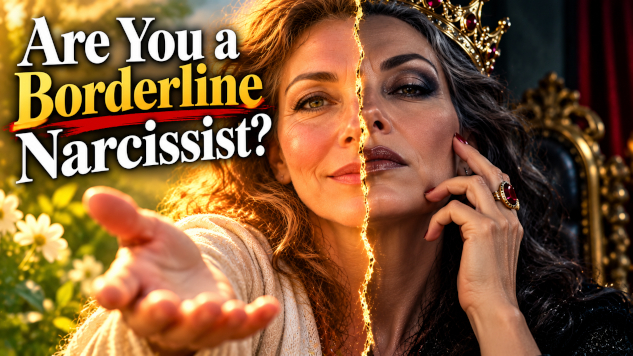
I was accused the other day of being a borderline narcissist. Now this rather surprised me, as I would not label myself as a narcissist. But, I took the concept and reflected upon it. I also did some research on the definitions of narcissism so I could better understand it. Then I looked within myself to see if there was such a behavior living inside of me.
Now, I'm not referring to a clinical diagnosis here. I'm using the word borderline, as my friend did, in its everyday sense, meaning that perhaps we sometimes cross the line between healthy self-love and being solely focused on ourselves.
There is a clinical diagnosis called narcissistic personality disorder (NPD). So to be clear, this is not what we're discussing here. NPD is a specific mental health condition, rather than simply an extreme amount of self-love or self-aggrandizement.
There is something called healthy narcissism, and it involves a healthy sense of self and love of self. It does not negate or exclude love of others. Healthy narcissism is basically part of the process of discovering and experiencing love.
Of course, there is a difference between having a healthy sense of self and being narcissistic in the negative sense. What I'm referring to here is the natural need to value ourselves, recognize our own needs, and consider our own well-being. The question is whether that concern for ourselves also includes others.
It has been said that babies are narcissistic. And so they are, in the sense that they are very focused on themselves and extremely focused on their needs. They are hungry, they cry. They have a wet diaper, they cry. They are stressed or afraid, they cry. Basically, they're saying: Pay attention to me! They have no regard for whether their parents are sleeping, or eating, or busy. They want what they want and they want it now.
However, as babies grow, they develop awareness and love for others. And that's a natural process of life. Yet this does not imply that their love for others negates or replaces love of self. There needs to be a balance where both reside in the same person.

When Does Narcissism Become Unhealthy?
We all have a concern for ourselves to some extent. That is natural and healthy. If you didn't care about yourself at all, you wouldn't eat, you wouldn't take care of yourself at all. You would basically ignore your own existence, which would lead to death.
The distinction becomes whether we expand that self-love to include the people close to us, and then expand it to include, as the First Nations people would say, all our relations. And that would include not just the two-leggeds, but the four-legged and everything in the world.
I think there are numerous examples of unhealthy narcissism in the world around us. A basic example is when individuals or groups or corporations take actions that benefit themselves while blatantly hurting or disregarding the well-being of others.
So an example of this would perhaps be the person who blasts their stereo out in the yard in the middle of the night in utter disrespect for the well-being of their neighbors. And on a corporate level, dumping toxic chemicals in rivers that not only negatively affect people downstream, but also all the fish and creatures living in or depending on that water.
What comes to mind, as the opposite side of the scale, is the Buddhist principle of "Do no harm." And also the Christian teaching of "Love thy neighbor." And I'm sure if we were to dig into other religions, we would find similar concepts.
Healthy and Unhealthy Narcissism
So to respond to my friend who accused me of being a borderline narcissist, my answer is yes, perhaps I am. However, we need to keep in mind that there is a difference between healthy self-love and the unhealthy narcissistic behavior that disregards others. And I suppose we may all be guilty of the latter at times.
Unhealthy narcissism is not only unhealthy for the people around that person, but also for the person themselves, though they may not be aware of it. The person who consistently disregards the feelings and needs of others risks alienating the very people who might otherwise love and support them on their life's journey.
The narcissist probably, and I'm not an expert here but I'm going with my gut feeling on this, feels like they need to grab and take what they need, or what they think they need, no matter the consequences to others. They become so focused on their own needs and desires that they lose sight of the feelings and needs of others.
Narcissism on a Larger Scale
And what happens when this same disregard for others is no longer just an individual behavior, but becomes accepted by an entire society? What happens when taking what we want, regardless of the consequences to others, becomes the normal way of doing things?
I have been reading a book entitled We Are the Middle of Forever. It is a series of interviews with Native American Indians or First Nations people. This has led me to conclude that, when we consider narcissism as exclusively putting one's own wants and needs above those of others, the whole modern colonial system, aka civilized society, is an unhealthy form of narcissism.
People of European origin spread out throughout the world and took the land that was already occupied by others. Not only that, but they stripped them of the right to their own language, their religion, and traditional lifestyle and teachings.
This was done without consideration for the people already living in those conquered worlds. And of course, we can extend this to slavery. So the whole colonization process was an extreme form of unhealthy narcissism on a societal level.
Now I'm not saying that everyone who colonized faraway lands was intentionally evil or narcissistic. But their behavior was definitely not helpful to others who already resided where they were moving in. It's a bit as if you decided you really liked your neighbor's house and their yard, so you kick them out, or worst-case scenario, you kill them, and then you move in and claim it as your house and your yard.
This is an extreme form of disregard for others which we see continued in the world around us.
What Is the Antidote?
So what's the solution or the antidote? It all comes back to love, which includes others as well as self. It includes empathy and compassion as well as taking care of our own self and our family, but not to the exclusion or to the purposeful harm of others.
The psychoanalyst Heinz Kohut developed the concept of healthy narcissism, recognizing that a healthy sense of self is part of normal human development. His work connected this development with qualities such as self-esteem, ambition, creativity, and the ability to form meaningful relationships with others.
So early narcissism can be a stepping stone or a growth stage towards a healthy sense of self, which includes both love of self and love of others. Or if the term love is confusing, perhaps we can use respect of self and respect of others.
We Have Painted Ourselves into a Corner
So where do we go from here? What do we do now that we have painted ourselves into a corner?
In other words, our behavior, and I'm speaking both of personal behavior and societal behavior, has backed us up into a corner where we may not feel or see a way out of our dilemma.
But perhaps that's the first step: standing in the corner and reflecting on our behavior. Just as, when we were children, we might have been directed to sit in the corner of the room and reflect on what we had done wrong.
So perhaps humanity needs to take a deep breath, or probably several, and reflect on our behavior and how we've gotten to where we are.
And then we can turn around, make amends, and start living our life with a balanced form of love or respect which includes ourselves and all our relations.
Love thy neighbor as thyself. Examine your actions. Ask yourself: Are my actions benefiting only myself, or am I also contributing to the well-being of others?
And for all of us, if we are being honest with ourselves, we will probably find that some of our actions are not as considerate of others as they could be. After all, our society accepts, and even promotes, greed and hoarding of food, possessions and even time, while people are hurting and in great need.
We need to go back to seeing our existence as a communal one. We are all connected and we are all interdependent, and the well-being of one is not to the exclusion of the well-being of another. We are all pieces in this huge puzzle of life.
So we start where we always have to start, with our own self. We examine our behavior and remove from it those behaviors that are deliberately harming others or harming the planet. And from there we can start being aware of those harms that are unintentional consequences of our actions.
Living in Harmony and Grace
This is how we will be able to survive and thrive on this wonderful planet that we have been gifted. Our goal is not to have dominion over either the planet or other beings, but to live in harmony and in grace and with love, in a true Garden of Eden.
The story comes to mind of the definition of Heaven and Hell. As the story goes, people are sitting around a huge table with an abundant bowl of food in the middle, and they each have a spoon with an unusually long-handle.
In Heaven, they use the spoon to feed each other, whereas in Hell, each person struggles, without success, to use the long spoon to only feed themselves.
So who are we feeding, both physically, emotionally, and spiritually? The answer to that question decides the quality of our life from this moment onward.
About The Author
 Marie T. Russell is the founder of InnerSelf Magazine (founded 1985). She also produced and hosted a weekly South Florida radio broadcast, Inner Power, from 1992-1995 which focused on themes such as self-esteem, personal empowerment, and well-being. Her articles focus on transformation and reconnecting with our own inner source of joy and creativity.
Creative Commons 3.0: This article is licensed under a Creative Commons Attribution-Share Alike 4.0 License. Attribute the author: Marie T. Russell, InnerSelf.com. Link back to the article: This article originally appeared on InnerSelf.com
Related Books:
-
We Are the Middle of Forever: Indigenous Voices from Turtle Island on the Changing Earth
Edited by Dahr Jamail and Stan Rushworth, this collection of conversations with Indigenous thinkers and leaders offers perspectives on humanity's relationship with the Earth. It emphasizes interconnectedness, responsibility, and respect for all living beings, challenging the belief that human needs should take precedence over everything else.
Amazon: https://www.amazon.com/exec/obidos/ASIN/1620978598/innerselfcom
-
Self-Compassion: The Proven Power of Being Kind to Yourself
Kristin Neff examines how treating ourselves with kindness can foster emotional resilience and healthier relationships. She explains the difference between self-compassion and self-centeredness, showing how recognizing our shared humanity can strengthen our capacity for empathy and understanding.
Amazon: https://www.amazon.com/exec/obidos/ASIN/0061733520/innerselfcom
-
All About Love: New Visions
bell hooks examines love as something we practice through care, honesty, respect, and responsibility rather than simply an emotion we experience. She considers how our relationships and social institutions can reflect either a commitment to mutual well-being or a disregard for others, offering a vision of love rooted in compassion and community.
Amazon: https://www.amazon.com/exec/obidos/ASIN/0060959479/innerselfcom
Article Recap:
Healthy self-love does not require us to disregard the needs of others. By examining our behavior and recognizing where self-interest becomes harmful, we can move toward greater empathy, compassion, and respect. Our well-being is connected to the well-being of others, and the choices we make determine whether we contribute to that harmony.
#BorderlineNarcissist #HealthyNarcissism #SelfLove
#NarcissisticBehavior #SelfAwareness #PersonalGrowth
#Empathy #Compassion #HealthyRelationships
#LivingInHarmony #InnerSelfcom #MarieTRussell
Are You a Borderline Narcissist?