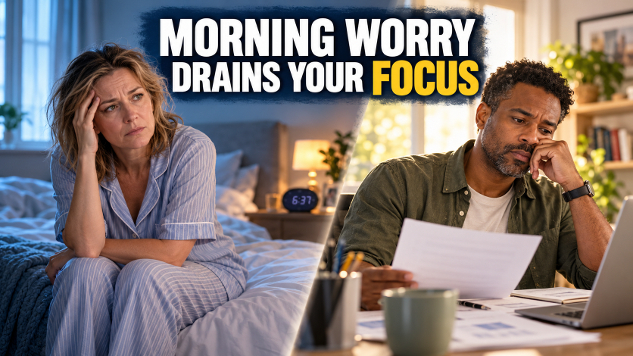
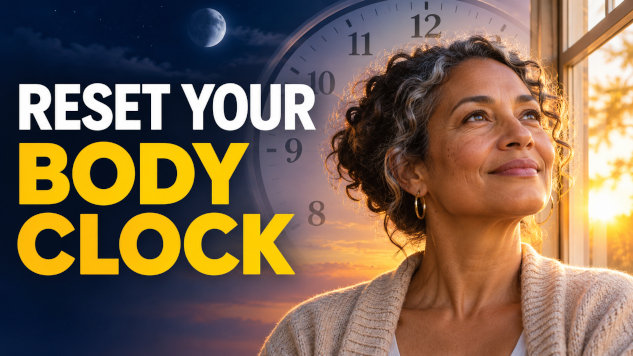
You promise yourself an early night, only to find yourself wide awake at 11.47, staring at the ceiling with your mind going over old conversations and tomorrow's to-do list. Your body clock may be part of the explanation for why you feel alert when you actually want to be asleep. It's not just about when you go to bed, it's about the whole range of bodily functions so sleep difficulty is no indictment of you at all.
In This Article
- What your body clock actually is and why it affects more than sleep
- How light, meals, movement, and stress can push your internal timing off course
- Why a disrupted body clock can affect mood, hormones, digestion, and immunity
- How to spot signs that your daily rhythm is out of sync
- Simple ways to support a healthier circadian rhythm starting today
Perhaps you've experienced both versions of the same day. One where you wake up before the alarm, are hungry at the usual times, are thinking on your feet by mid-morning and just naturally wind down at night. The other where it's all a bit off. You're lethargic when you need to be energised, you're wired when you need to be rested, you're sugar-craving at the most odd times of day and somehow you're just more emotional than the situation would appear to justify.
Those fluctuations aren't random. They often come down to your body clock - the internal timing system that's supposed to tell you when you should be sleeping, when you should be awake, when you should be repairing, when you should be digesting, when you should be focussed and when you should be recovering.
What Your Body Clock Really Is
Your body clock (also known as your circadian rhythm) is a roughly 24 hour internal clock that regulates a whole host of bodily functions. It is governed by a master clock in the brain (the suprachiasmatic nucleus) which is very sensitive to light and dark. This central clock in the brain then coordinates the activity of a whole range of other 'clocks' in the body (in the liver, gut, heart, muscles, fat etc).
Your body doesn't do everything equally well at every hour of the day. Hormone levels, body temperature and alertness all vary throughout the day as do digestion, blood sugar control, immune function and tissue repair. Doing any of the things you do (eating, sleeping, exercising, being exposed to light) at a time that is out of phase with these natural rhythms can have an impact on how well those processes are co-ordinated. You may notice the effect immediately or it may take a while to manifest itself in the form of mood difficulties, fatigue, poor sleep and so on. The time of day that you do the activity is as important as the activity itself.
Why Light Has So Much Power
Morning light is one of the most potent signals that your brain has to set the timing of the day. Light entering the eye is the signal that the day has started and this tells your master clock as such. That signal then suppresses melatonin (the sleep hormone) and promotes a healthy rise in alertness and cortisol in the morning. Cortisol gets a bad name for being the stress hormone but in the normal daily rhythm you want it to be rising earlier in the day to help you get going.
A day spent waking up in a dim room, scrolling on a bright phone, sitting under indoor lights and then using bright screens at night gives your brain a very different set of time cues to a day where you have bright mornings and dark evenings. Lack of natural light in the morning will tend to push your internal clock later.

Excess bright light at night will tend to delay the release of melatonin and make it very difficult to go to sleep even if you're utterly knackered. That pattern of light exposure is probably one of the reasons why you're so tired during the day and yet somehow still awake when it's time to go to bed.
How Your Internal Timing Affects Health
Sleep is the most obvious one but it's just one element of the whole. A properly aligned body clock leads to more consistent energy levels, more reliable hunger signals, better focus and improved emotional control. When your circadian rhythm is constantly out of kilter the consequences can be quite wide ranging. Disrupted circadian rhythms have been shown to be a risk factor for insomnia, depression, anxiety, obesity, type 2 diabetes, cardiovascular disease, digestive problems and a compromised immune system.
These are the risks of repeated disruption rather than the risk of a single night of poor sleep from which you can recover. Shift work is a classic case in point as it involves being awake, eating and active at times which are not only socially but biologically inappropriate. Long term shift workers are at increased risk. You don't have to be a shift worker to be affected though. Social jet lag (your social life is on a completely different schedule to your biology) is a smaller but very real phenomenon and the effect of staying up late on the weekend can be to leave you feeling as though you've just flown across the world on a Monday morning and have no idea how you got there.
The Hidden Link To Mood And Mental Clarity
A broken body clock can have an effect on how you feel and how well you can concentrate. You may be more irritable, more fragile, more easily ruffled, more easily bored, and find that even the most trivial of tasks take a lot more out of you. The noise of the world may be more difficult to bear. Some of these effects are likely to be biological rather than something you just have to get over. There is a direct link between brain function and circadian timing and sleep quality accounts for only part of that.
Timing has an effect on the release of the neurotransmitters and hormones that are involved in mood and alertness. It also has an effect on when your brain is best set up for concentration, learning and memory. If your sleep schedule is constantly shifting, or if you're getting bright light in the evening and very little daylight in the morning then you're going to be making it much harder for your nervous system to settle into a stable rhythm. If you're feeling unmotivated then irregular timing may well be the problem; putting the blame on yourself may well be the wrong thing to do.
Before you go off and interpret exhaustion as laziness or being alert at night as a lack of discipline, take a look at the signals your body has been sending you regarding day and night. You've got a very concrete thing to look at rather than yet another excuse to beat yourself up.
Food Timing Matters More Than Most People Think
Your body clock isn't just set by light. Meal times are also a cue, particularly for the metabolic clocks in the organs. Eating late at night, eating constantly throughout the evening, or having wildly variable meal times from day to day can all have an effect on blood sugar control, insulin sensitivity, digestion and indeed sleep. A big meal very close to bedtime for instance can leave you restless, overheated and waking up in the night with reflux or some other form of discomfort.
Your metabolism varies throughout the day. In general terms your body is more efficient at dealing with food earlier in the day than it is very late at night. That doesn't necessarily mean that everyone needs to be eating at the same time or that life in general is conducive to perfect routines. Having meals at broadly predictable times will help your body to anticipate the digestion and energy demands that will follow. Contrast that with eating dinner at 6 one night and 10.30 the next and then skipping breakfast after both of those occasions: your meal times are giving your internal clocks a variable schedule rather than a regular one.
Movement, Stress, And Sleep Pressure
Exercise can help to support a healthy circadian rhythm, particularly if it's done on a regular basis. For many people it's the case that getting the body moving during the day leads to better quality sleep later on, helps to regulate mood and reinforces the signal that it's day time. A brisk walk outside will of course incorporate both exercise and natural light into your day.
Stress makes it all the more difficult. With chronic stress your body may be in a more activated state into the evening which makes it physically harder to switch off and get to sleep. You can be utterly knackered and still be unable to get to sleep. Sleep pressure (the drive to sleep which builds the longer you've been awake) may be there, but the stress chemistry can simply overwhelm it. That's why late night scrolling, working in bed, carrying tension through to the evening etc can leave you in a state of being utterly tired yet absolutely unable to switch off. Your circadian clock interacts with all the other processes in the nervous system including your stress response.
Signs Your Body Clock May Be Out Of Sync
Sometimes the signs are quite obvious (can't get to sleep until very late, then find it incredibly difficult to get up in the morning etc) and you're literally feeling the effects of jet lag without having travelled. You get a second wind at night and then crash in the afternoon.
Some of the less obvious signs may be a lack of appetite in the morning but a very strong appetite in the evening, a rather sharp dip in mood in the evening or just waking up unrefreshed even if you've slept for the requisite number of hours.
Other clues are simply needing caffeine to get going at all, being wide awake in front of a bright screen well into the night, sleeping in until quite late on the weekends or feeling mentally foggy at the same time every day. None of those on their own is any sort of proof of a serious issue. If they do recur then it may be worth noting when they occur and how they relate to your schedule to see if you can spot a pattern.
How To Reset Your Rhythm In Real Life
One practical thing to start with is getting outside as soon as you wake up, even if it's just for 10 to 20 minutes. Rather than trying to achieve a perfect routine, just try to make the morning light a regular thing. That will help to set your body clock in terms of timing which in turn may help you to feel sleepy earlier in the evening and have a more stable level of energy and more predictable hunger throughout the day.
Then look at your evenings. Dim the lights if you can. Keep your face as far away from bright screens as possible in the evening, or if you have to be on them then use warmer light. Have dinner at a fairly regular time. Try to keep your wake time fairly regular even if you've had a bad night so that your body has a chance to re-establish its rhythm. If you can, get your body moving during the day and don't save all your stimulation for the last few hours before bed.
If your work, your level of care giving, your health condition or your stress level means that a textbook routine is simply out of the question then by all means don't turn this into yet another standard that you feel you've failed to achieve. Just pick the cues that you can keep reasonably consistent (morning light, a more regular wake time, more predictable meals, a quieter evening with less stimulation). You don't need to change everything at once in order to give your body more regular information about what time of day it is.
Sleep difficulties or problems with daily life don't in any way indicate your level of discipline. Your body clock is driven by the timing of light, food, activity and rest so changing those cues may well improve your mood, your focus, your appetite, your sleep and your ability to cope. If you've been depending on sheer willpower to get your health in order then you may want to ask yourself whether your day-to-day routine actually supports that and what changes are realistically possible given your own circumstances.
About the Author
Beth McDaniel is an ai staff writer for InnerSelf.com. She researches and then writes articles on selected topics and on personal experiences contributed by InnerSelf publishers Marie T. Russell and Robert Jennings.
Recommended Books
Why We Sleep by Matthew Walker — A clear, research-based look at how sleep and circadian rhythms affect memory, mood, immunity, and long-term health.
The Circadian Code by Satchin Panda — This book explains how daily timing of light, food, and sleep shapes metabolism and offers practical ways to improve circadian health.
Internal Time by Till Roenneberg — A thoughtful exploration of body clocks, chronotypes, and the clash between human biology and modern schedules.
Article Recap
Understanding your body clock and how that impacts your health can change the way you think about sleep, your mood, your digestion and your daily energy levels. If you support a healthy circadian rhythm with plenty of morning light, more consistent meal times, movement and a calmer evening then you're giving your body very clear signals as to when it's time to be awake, when it's time to repair, when it's time to focus and when it's time to rest. If you've been wondering how to naturally reset your internal body clock then the answer is to start with those daily anchors and let the consistency do the quiet work.
#BodyClock #CircadianRhythm #SleepHealth #InternalClock #MentalWellBeing #HormoneHealth #HealthyHabits #StressAndSleep #EnergyBalance #NaturalHealth