
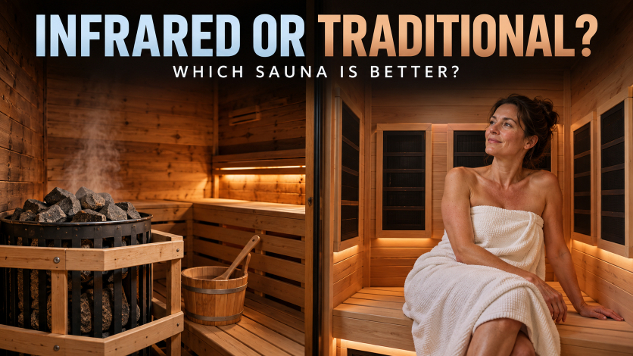
The debate over the benefits of infrared versus traditional saunas continues, with claims about detoxification and comfort often misleading. While both types offer health benefits, evidence suggests that traditional saunas have more robust research backing their positive effects on health, including cardiovascular and respiratory improvements.
In This Article
- What are the claims about infrared saunas?
- What distinguishes infrared saunas from traditional ones?
- How do the mechanisms of sauna use affect health?
- What practical benefits can sauna bathing provide?
- What are the limitations of sauna research?
If you follow wellness trends, you might’ve come across the claim that an infrared sauna, which heats the body with light, is better for you than a traditional sauna, which uses radiant heat from a stove.
In short, this claim is a myth, and is not supported by any strong comparative evidence. While there are differences between infrared and traditional saunas, the limited evidence we do have suggests both types of sauna are good for your health.
The claim
Typically one of two things will be suggested: that the type of heat produced by infrared leads to stronger detoxifying effects; or that the lower temperature is more comfortable, leading to a longer stay and therefore greater effect.
As for the first claim, there is no evidence detoxification is the main reason you feel good after a sauna. The excretion of heavy metals may have therapeutic benefit in limited cases, but it is not clear how well sauna achieves this, or whether there is any significant difference between traditional and infrared in this regard.
The second claim – that the lower temperature of infrared makes it more effective than traditional sauna – may apply at the level of personal preference, but has no scientific backing.
Traditional sauna: an overview
Saunas are at least 2,000 years old, and have been a popular social activity in many cultures. The European type has become the traditional sauna we know today – a room with wooden walls and a large stove. The defining characteristic is the use of water to create steam over a pile of hot rocks.

Today, traditional saunas can be heated by fire, gas, or most commonly, electricity. They’re typically heated between 70º-90ºC. Standard practice is to sit in the heat for 10-20 minutes, take a break (including a plunge in cold water if available), and then get back into the sauna; sometimes repeating the cycle multiple times.
After decades of scattered research, a Finnish team recently found associations between regular sauna bathing and positive outcomes in areas such as cardiovascular health, blood pressure, respiratory illness, and even dementia. Their largest study was based on a cohort of 2,315 middle-aged men, with a 20 year follow up period. The average temperature was 77ºC, and better outcomes were observed in participants who used sauna the most (four times per week or more).
While the precise mechanisms are still not understood, the researchers suggest the physical effects of sauna – including heart rate, blood pressure, and cellular response – correspond to similar benefits seen with regular physical exercise.
How does infrared sauna compare?
Infrared technology is not new, but infrared sauna has only gained popularity in recent decades. Designed to look like traditional saunas, the modern infrared sauna includes heating panels in the walls (no stove). The ambient temperature is normally much lower, between 40º-60ºC. However, the penetrating nature of infrared heat makes you sweat profusely, and your thermoregulatory system responds in a similar (but not identical) way.
Typically you will begin to sweat quickly, but the lower temperature means a lower heart rate. Sessions in an infrared sauna can often last for around 30-45 minutes. This is why some people suggest that it is more comfortable, and potentially safer.
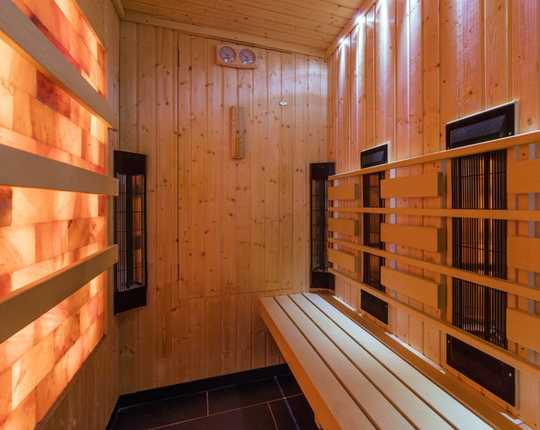
The heat in an infrared sauna comes from panels on the walls. From shutterstock.com
However, traditional sauna often involves multiple rounds of heat, so it’s easy to accumulate 45 minutes (or longer) with cool-down breaks in between. Higher temperatures also produce exercise-like effects more quickly. For example, the positive results seen in recent Finnish studies include many people whose sessions typically last for only 10-20 minutes.
Infrared sauna is also less social. While some infrared devices are built for more than one person, the tendency is towards individual bathing.
Any sauna is better than no sauna
While infrared is gaining popularity, research is lacking, and the vast majority of published research relates to traditional sauna (which itself is limited in terms of strong evidence).
The closest thing we have to comparative evidence is a recent systematic review – the first to compare studies of both traditional and infrared sauna. This review concludes that all positive outcomes seen with infrared sauna simply reinforce what is already known about traditional sauna.
There is much still to be explored on the health benefits of sauna. In the meantime, the take-home message is to use whatever sauna you like. Try different things, and listen to your body. Maybe you prefer the calm, private, softer nature of infrared sauna. Or maybe you prefer the fuller sensory experience of traditional sauna, including the heat, the steam, the smell, and the people.
Whatever the case, you will feel good afterwards. So get out there, and start sweating.
About The Author
Jack Tsonis, Lecturer, Graduate Research School, Western Sydney University
This article is republished from The Conversation under a Creative Commons license. Read the original article.
Further Reading
-
Sauna: The Power of Deep Heat
Emma O’Kelly explores sauna culture, its history, and the environments that make heat bathing a distinctive experience. The book offers a broader perspective on relaxation, community, and the sensory appeal of sauna beyond competing wellness claims.
Amazon: https://www.amazon.com/exec/obidos/ASIN/1801292426/innerselfcom
-
Bad Science: Quacks, Hacks, and Big Pharma Flacks
Ben Goldacre explains how weak studies, misleading statistics, and selective reporting can make health claims sound more convincing than they are. His accessible examples help readers evaluate promises about detoxification and distinguish personal testimonials from reliable comparative evidence.
Amazon: https://www.amazon.com/exec/obidos/ASIN/0865479186/innerselfcom
-
Do You Believe in Magic?: The Sense and Nonsense of Alternative Medicine
Paul A. Offit examines popular health treatments and the evidence used to support them. He encourages readers to consider demonstrated benefits, possible harms, and the difference between feeling better and proving a specific therapeutic effect.
Amazon: https://www.amazon.com/exec/obidos/ASIN/0062222961/innerselfcom
Article Recap
Both infrared and traditional saunas offer health benefits, but traditional saunas are better supported by research. It is advisable to choose the type that feels best personally while remaining mindful of the limited evidence surrounding infrared saunas.
#InnerSelfcom #InfraredSauna #TraditionalSauna #SaunaHealth #WellnessTrends #CardiovascularHealth #Detoxification #HeatTherapy